

SCHOLARSHIP APPLICATION: (Deadline: APRIL 30th, 2027)
Please ensure all fields are filled in completely.To view previous winner: Click Here
(IF YOU HAVE ANY QUESTIONS, PLEASE EMAIL THE PROGRAM ADMINISTRATOR AT RYAN@STUDENTSCHOLARSHIPS.ORG)
Control Valve for Forklift
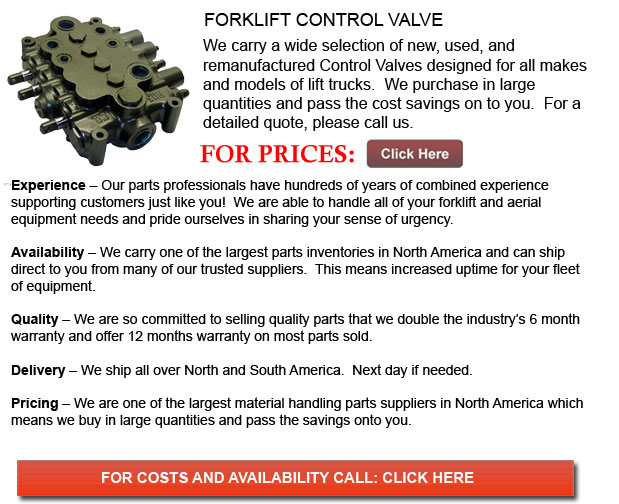

Control Valve for Forklift - The earliest mechanized control systems were being used more that two thousand years ago. In Alexandria Egypt, the ancient Ktesibios water clock built in the third century is considered to be the very first feedback control machine on record. This clock kept time by regulating the water level inside a vessel and the water flow from the vessel. A popular style, this successful equipment was being made in a similar manner in Baghdad when the Mongols captured the city in 1258 A.D.
Different automatic devices through history, have been utilized in order to accomplish certain jobs. A common style used throughout the 17th and 18th centuries in Europe, was the automata. This piece of equipment was an example of "open-loop" control, comprising dancing figures which will repeat the same job repeatedly.
Closed loop or also called feedback controlled machines comprise the temperature regulator common on furnaces. This was actually developed during the year 1620 and accredited to Drebbel. Another example is the centrifugal fly ball governor developed during the year 1788 by James Watt and used for regulating the speed of steam engines.
The Maxwell electromagnetic field equations, discovered by J.C. Maxwell wrote a paper in 1868 "On Governors," which was able to explaining the exhibited by the fly ball governor. To be able to explain the control system, he used differential equations. This paper demonstrated the usefulness and importance of mathematical methods and models in relation to comprehending complex phenomena. It likewise signaled the beginning of mathematical control and systems theory. Previous elements of control theory had appeared earlier by not as dramatically and as convincingly as in Maxwell's study.
In the next 100 years control theory made huge strides. New developments in mathematical methods made it feasible to more precisely control significantly more dynamic systems than the first fly ball governor. These updated techniques consist of different developments in optimal control during the 1950s and 1960s, followed by development in stochastic, robust, optimal and adaptive control techniques during the 1970s and the 1980s.
New applications and technology of control methodology has helped produce cleaner engines, with more efficient and cleaner processes helped make communication satellites and even traveling in space possible.
In the beginning, control engineering was practiced as just a part of mechanical engineering. Control theories were initially studied with electrical engineering in view of the fact that electrical circuits can simply be explained with control theory techniques. At present, control engineering has emerged as a unique discipline.
The very first control relationships had a current output that was represented with a voltage control input. As the correct technology in order to implement electrical control systems was unavailable at that moment, designers left with the alternative of slow responding mechanical systems and less efficient systems. The governor is a really effective mechanical controller which is still often used by several hydro plants. Eventually, process control systems became available before modern power electronics. These process controls systems were normally used in industrial applications and were devised by mechanical engineers utilizing hydraulic and pneumatic control devices, lots of which are still being utilized these days.
Click to Download the PDF
Forklift Parts


TOLL FREE: 1-888-695-7994
forkliftpartswestvirginia.com
Email Us
About Us