

SCHOLARSHIP APPLICATION: (Deadline: APRIL 30th, 2027)
Please ensure all fields are filled in completely.To view previous winner: Click Here
(IF YOU HAVE ANY QUESTIONS, PLEASE EMAIL THE PROGRAM ADMINISTRATOR AT RYAN@STUDENTSCHOLARSHIPS.ORG)
Steer Axles for Forklift
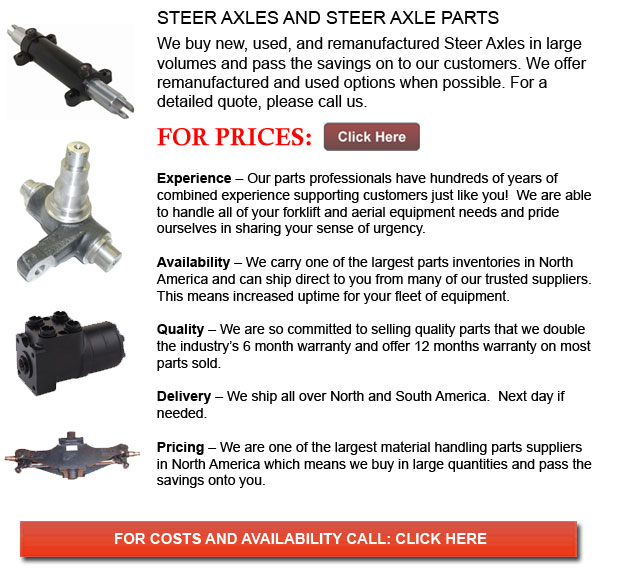

Steer Axles for Forklifts - Axles are defined by a central shaft which turns a wheel or a gear. The axle on wheeled vehicles could be connected to the wheels and rotated along with them. In this particular situation, bushings or bearings are provided at the mounting points where the axle is supported. On the other hand, the axle can be connected to its surroundings and the wheels could in turn rotate all-around the axle. In this situation, a bearing or bushing is situated in the hole within the wheel to allow the wheel or gear to rotate around the axle.
If referring to trucks and cars, several references to the word axle co-occur in casual usage. Usually, the term means the shaft itself, a transverse pair of wheels or its housing. The shaft itself turns along with the wheel. It is usually bolted in fixed relation to it and called an 'axle shaft' or an 'axle.' It is equally true that the housing surrounding it which is usually known as a casting is otherwise called an 'axle' or sometimes an 'axle housing.' An even broader sense of the term means every transverse pair of wheels, whether they are attached to one another or they are not. Therefore, even transverse pairs of wheels in an independent suspension are generally called 'an axle.'
The axles are an important component in a wheeled vehicle. The axle works to transmit driving torque to the wheel in a live-axle suspension system. The position of the wheels is maintained by the axles relative to one another and to the vehicle body. In this system the axles must likewise be able to support the weight of the motor vehicle along with whichever load. In a non-driving axle, as in the front beam axle in various two-wheel drive light trucks and vans and in heavy-duty trucks, there will be no shaft. The axle in this particular situation serves just as a steering part and as suspension. Lots of front wheel drive cars consist of a solid rear beam axle.
There are different kinds of suspension systems where the axles operate just to transmit driving torque to the wheels. The position and angle of the wheel hubs is a function of the suspension system. This is usually found in the independent suspension seen in the majority of brand new sports utility vehicles, on the front of numerous light trucks and on the majority of brand new cars. These systems still consist of a differential but it does not have fixed axle housing tubes. It could be connected to the motor vehicle frame or body or even could be integral in a transaxle. The axle shafts then transmit driving torque to the wheels. The shafts in an independent suspension system are like a full floating axle system as in they do not support the vehicle weight.
The motor vehicle axle has a more vague description, meaning that the parallel wheels on opposing sides of the motor vehicle, regardless of their kind of mechanical connection to one another.
Click to Download the PDF
Forklift Parts


TOLL FREE: 1-888-695-7994
forkliftpartswestvirginia.com
Email Us
About Us